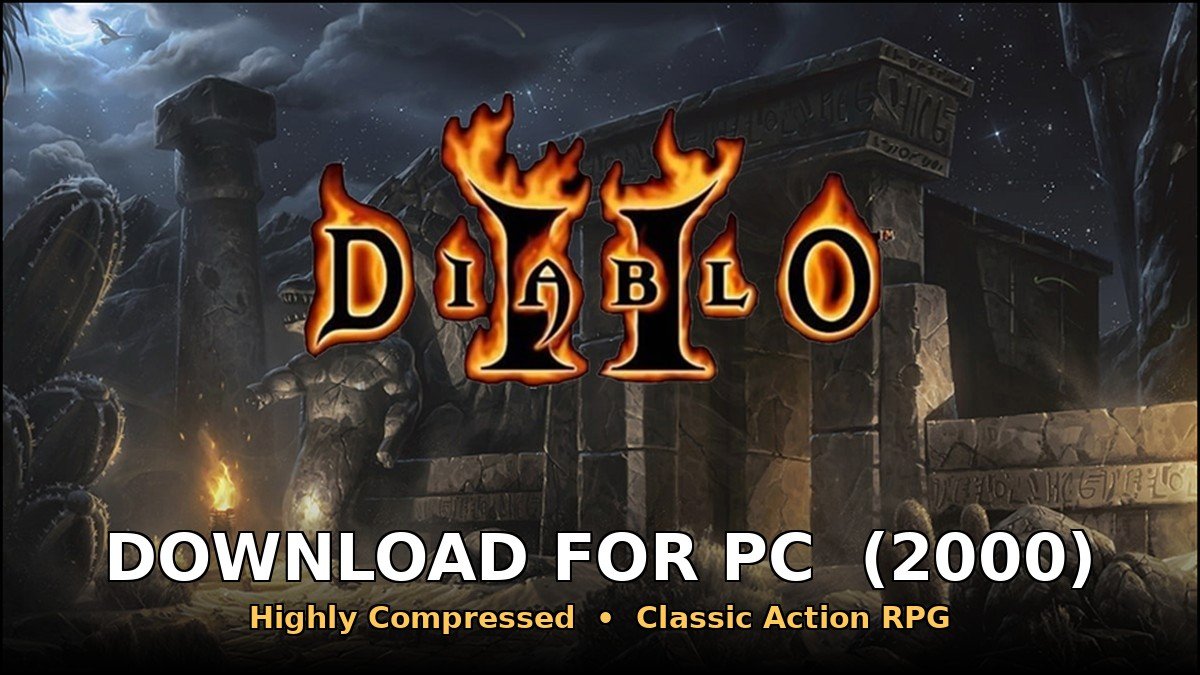

Diablo 2 Download for PC Highly Compressed (2000)
Some games age, and some games refuse to age at all. Diablo II belongs to the second group, and that is why people are still searching for diablo 2 download for pc highly compressed more than twenty-five years after it first came out. It is not nostalgia alone that keeps this game alive. It is the loop itself — kill monsters, pick up loot, get a little stronger, go a little deeper, and tell yourself you will stop after one more run, and then you do not stop.
If you have a weak PC, a slow connection, or just a soft spot for the games that built a whole genre, Diablo II is still one of the best downloads you can make, and it runs on hardware that would struggle to open a modern web browser properly.
The game came out in the summer of 2000, when most action games were still figuring out how to tell a story while you played. Diablo II did not wait for permission. It threw you into a dark world, gave you five very different heroes to choose from, and let the dungeon do the talking. There were no long tutorials holding your hand, no markers telling you exactly where to stand. You learned by playing, by dying, and by coming back with a better plan and a better sword. That honesty is a big part of why it still works in 2026.
What makes the highly compressed version so popular is simple practicality. The original game is small by today’s standards — the full install was under a gigabyte — so a compressed copy is genuinely light, quick to download, and easy to keep on an old laptop or a low-end PC that has almost no free space left. You do not need a graphics card, you do not need sixteen gigabytes of RAM, and you do not need to clear half your hard drive. Give it an evening, and you will understand why this game has never really gone away.
Diablo II Game Information
| Game Name | Diablo II |
|---|---|
| Release Date | 29 June 2000 (North America, Windows) |
| Developer | Blizzard North |
| Publisher | Blizzard Entertainment (North America), Sierra (Europe) |
| Genre | Action Role-Playing Game, Hack and Slash, Dark Fantasy |
| Game Mode | Single-player, Multiplayer (Battle.net / LAN) |
| Platform | PC (Windows), Mac |
| File Size | Original install about 650 MB; full / multiplayer install about 950 MB. Compressed size varies by repack — do not trust a single MB figure from an unverified source. |
| Age Rating | M (Mature 17+) |
| Expansion | Diablo II: Lord of Destruction (29 June 2001) |
| Remaster | Diablo II: Resurrected (23 September 2021) |
What Is Diablo II?
Diablo II is an action role-playing game developed by Blizzard North and released for Windows on 29 June 2000. It is the sequel to Diablo (1996), and it takes the first game’s simple idea — go down into a dungeon, kill demons, find better gear — and turns it into a full journey across a whole world. The game is set in Sanctuary, a dark fantasy world caught between Heaven and Hell, and you play a new hero chasing the Dark Wanderer, a man who is slowly being taken over by Diablo himself.
The story picks up shortly after the first game. At the end of Diablo, the hero who killed Diablo tried to contain the demon by driving its Soulstone into his own head. It did not work. The Soulstone corrupted him instead, and he became the Dark Wanderer, walking east across Sanctuary while Diablo’s power grew inside him. Your hero follows that trail, and the chase takes you through four acts, each one in a completely different place, each one ending with a boss that tests everything you have learned so far.
What made Diablo II different from almost everything else in 2000 was scale. The first Diablo was one town and one dungeon. Diablo II gives you a Rogue Encampment, a desert city, a jungle, and Hell itself. The wilderness areas between dungeons are partly random, so the map is never exactly the same twice. The loot is random too — most drops are ordinary, some are rare, and once in a while something drops that changes your whole build. That randomness is the engine of the game.
The Story of Diablo II
The story is told in pieces — in short cutscenes between acts, in the words of Deckard Cain, and in the places you walk through. It starts quietly enough. You arrive at the Rogue Encampment, a small fort full of frightened archers, and you learn that demons have taken the monastery nearby. That first act teaches you the rhythm of the whole game: clear an area, find a quest, kill the boss, move on.
Act I ends with Andariel, the Maiden of Anguish, waiting in the depths of the monastery. Act II moves east to Lut Gholein, a desert city built around trade and tombs, where the trail leads through dusty crypts and the Arcane Sanctuary to the Tomb of Tal Rasha, and to Duriel, the Lord of Pain. Act III crosses the ocean to Kurast, a jungle city falling apart under Mephisto, the Lord of Hatred, and his corrupted council. Act IV is the shortest and the hardest — Hell itself, a place of rock, lava and a ruined cathedral, where you have to destroy Mephisto’s Soulstone and face Diablo, the Lord of Terror, one last time.
Gameplay — How Diablo II Plays
Diablo II plays from a top-down, isometric view. You click to move, you click to attack, and your skills sit on the mouse buttons and the number keys. That sounds simple, and the first ten minutes are simple. Then the systems start to open up, one after another, and you realise how much depth is hiding under that simple control scheme.
Every character has three skill trees, and every level gives you skill points and stat points to spend. You choose where they go, and those choices matter. A Sorceress who puts everything into fire plays nothing like one who puts everything into ice. A Barbarian who dual-wields swords is a different character from one who carries a huge two-handed axe and shouts war cries. There is no single right build, and there is no way to undo a bad choice easily, which is why the game rewards planning and punishes rushing.
The other half of the game is loot. Monsters drop weapons, armour, rings, amulets, charms, gems and runes, and almost everything can be sold, traded, socketed or combined. The Horadric Cube, which you find in Act II, lets you combine items into new ones, upgrade gems, and turn junk into something useful. Set items and unique items have fixed names and special powers, and finding one of them is the kind of moment that makes you sit up straight.
There are three difficulty levels — Normal, Nightmare and Hell — and you play through all four acts on each one. The same monsters come back stronger, with new immunities and better loot, and your character has to keep up. The level cap is 99, and almost nobody reaches it casually, which is fine, because the game is not really about reaching the cap.
Diablo II Game Features
Diablo II was packed with ideas in 2000, and a lot of them became standard for the whole action RPG genre afterwards.
Five Very Different Classes
You choose one of five classes at the start, and that choice changes everything. The Barbarian is a pure melee fighter who can dual-wield weapons and shout buffs that help the whole party. The Sorceress is a spellcaster who controls fire, lightning and cold, and can teleport across the screen. The Amazon fights with a bow, a javelin or a spear, and is deadly at range. The Necromancer raises skeletons and golems, curses his enemies, and lets his army do the fighting. The Paladin is a holy warrior who fights up close and carries auras that strengthen himself and anyone near him. Each class has three skill trees, so even two players with the same class can play in completely different ways.
Four Acts in Four Different Worlds
Each act looks, sounds and plays differently. Act I is a medieval monastery and the forests around it. Act II is desert, tombs and a palace that feels like it belongs in a story about crusaders. Act III is jungle, ruined temples and a city being eaten alive by its own priests. Act IV is Hell, short, brutal and unforgettable. The variety keeps the game fresh, because just when you are getting used to one kind of enemy, the game moves you somewhere new and hands you a new problem.
Random Maps and Random Loot
The wilderness areas and dungeons are partly generated at random, so you cannot just memorise the map and walk it blind. The loot is random too, and it is the randomness that makes the game replayable. You can play the same act ten times and get ten different drops, ten different maps, and ten different stories to tell.
Skill Trees That Reward Planning
Every level gives you five stat points and one skill point, and you decide where they go. Strength lets you wear heavier gear, Dexterity helps you hit and block, Vitality gives you life, and Energy gives you mana. Skills get stronger as you put more points into them, and some skills only unlock after you have spent points on the ones before them. A little planning at level ten saves a lot of regret at level forty.
All Five Classes in Diablo II
The Barbarian is the simplest class to learn and one of the hardest to master. He fights up close, he can carry two weapons at once, and his war cries can raise the attack, defence and life of everyone nearby. If you like walking into a crowd of monsters and walking out again, start here. His weakness is range — anything that shoots at him from far away has to be chased down first.
The Sorceress is the opposite. She is fragile, she has very little life, and she dies quickly if something reaches her. But she does more damage than anyone else, she can teleport, and she can freeze a whole screen of enemies solid. If you like planning your attacks and staying one step ahead, she is the most rewarding class in the game.
The Amazon is the most flexible class. She can fight at range with a bow or a javelin, or up close with a spear, and her skills cover both. Her Valkyrie, a powerful warrior she can summon, fights beside her and takes the hits she cannot. She is a good middle choice if you cannot decide between melee and ranged, and she is strong in every act.
The Necromancer is the class for players who like to think ahead. He raises skeletons from dead enemies, he summons a golem made of clay, blood, iron or fire, and he curses his enemies so they hurt themselves, move slowly, or take more damage. He is slow to start, and his first few levels can feel weak, but once his army is built, he is one of the safest classes to play.
The Paladin is a holy warrior who fights with a sword and a shield, and who carries auras that help himself and his party. One aura raises damage, another raises defence, another heals slowly over time. He is tough, he is forgiving, and he is a good choice for a first playthrough, especially if you want to play with friends. His weakness is that he has no long-range attack.
All Four Acts and Their Bosses
Diablo II is built around four acts, and each one ends with a boss that is harder than anything before it.
Act I takes place around the Rogue Encampment. You clear the Den of Evil, rescue Deckard Cain from Tristram, and fight your way through the monastery to Andariel, the Maiden of Anguish. She is fast, she poisons you, and she punishes players who stand still. Keep moving, keep your antidotes ready, and do not let her trap you in a corner.
Act II takes place around Lut Gholein. You find the Horadric Cube, explore the desert tombs, travel through the Arcane Sanctuary, and enter the Tomb of Tal Rasha to face Duriel, the Lord of Pain. Duriel is one of the hardest bosses in the game for a new player, because his chamber is small and his holy freeze aura slows you down the moment you step inside. Bring cold resistance and plenty of potions.
Act III takes place around Kurast. You travel through the jungle, fight the corrupted council, and enter the Durance of Hate to face Mephisto, the Lord of Hatred. Mephisto is slower than Andariel and Duriel, but he hits hard with lightning and cold, and the rooms before him are full of enemies that will follow you in if you are not careful. Clear the area first, then fight him on your own terms.
Act IV takes place in the Pandemonium Fortress and in Hell itself. It is the shortest act, with only three quests, but it is also the most intense. You destroy Mephisto’s Soulstone at the Hellforge, fight through the River of Flame, and enter the Chaos Sanctuary to face Diablo, the Lord of Terror. Diablo is big, fast and dangerous at every range, and his lightning and fire attacks can kill a careless player in seconds. This is the fight the whole game has been building towards.
Lord of Destruction — The Expansion That Finished the Story
Diablo II: Lord of Destruction came out on 29 June 2001, exactly a year after the original game, and it is one of the best expansions ever made for any game. It does not just add a little extra content. It finishes the story, adds two new classes, and improves almost every system in the game.
The expansion adds Act V, which takes place in and around Mount Arreat, in the northern Barbarian Highlands. After Diablo and Mephisto are defeated, the third Prime Evil, Baal, has survived, raised an army, and attacked the mountain to reach the Worldstone, a huge crystal that protects the mortal world from Heaven and Hell. You start in Harrogath, the Barbarian stronghold at the foot of the mountain, and you fight through the Bloody Foothills, the frozen highlands, and the caves beneath the mountain. There are six quests in Act V, and it ends with a fight against Baal himself in the Worldstone Chamber. It is a proper ending, and it makes the whole story feel complete.
Lord of Destruction also adds two new character classes. The Assassin is a fast, close-range fighter who uses martial arts, shadow techniques and traps she can lay and leave behind. The Druid is a shape-shifter and a summoner — he can turn into a Werewolf or a Werebear, call animals to fight beside him, and cast nature spells like volcano and hurricane. Both classes feel completely different from the original five, and both are worth a full playthrough on their own.
The expansion also raised the resolution to 800×600 alongside the original 640×480, gave players a much larger stash to store items in, and added new items, new runes, new monsters and new areas. If you are playing Diablo II in 2026, play it with Lord of Destruction included.
Diablo II: Resurrected — The 2021 Remaster
On 23 September 2021, Blizzard released Diablo II: Resurrected, a remaster of Diablo II and Lord of Destruction. It keeps the original gameplay, the original skill trees, and the original loot exactly as they were, and it rebuilds the graphics, the sound and the cutscenes for modern machines. You can switch between the old graphics and the new graphics with a single key press.
Resurrected is the easiest way to play Diablo II on a modern PC in 2026. The original 2000 version is still the one that runs on almost any old PC, and it is still the one most people mean when they search for a highly compressed download. The two versions are the same game underneath. If your PC is weak, play the original. If your PC is modern and you want the game to look its best, play Resurrected.
How to Download Diablo II Safely
This part matters, because the internet is full of bad copies of old games, and a bad copy can cost you more than the price of the game. Follow these steps, and do not skip them. If you came here searching for diablo 2 download for pc highly compressed, these steps keep your PC safe.
First, buy the game from an official source if you can. The official store is Blizzard’s Battle.net, where Diablo II: Resurrected is sold as a one-time purchase. That is the safest copy, it is the one that gets updates, and it is the one that will work online without any trouble.
Second, never download a game from a site you do not trust, and never run a file that your antivirus warns you about. A real game file will not ask you to turn off your antivirus, it will not ask you to install a second program you did not ask for, and it will not ask for your password. If a download page is full of flashing buttons that all say Download, close it and find another source.
Third, keep your copy clean. Scan any file you download before you open it, keep your antivirus turned on, and do not install extra toolbars, extra launchers, or extra programs that come bundled with a download. A clean install of Diablo II is small, it runs fast, and it does not need anything else to work.
How to Play Diablo II on PC
Playing Diablo II on a modern PC is straightforward, but a few setup steps will save you a lot of frustration later. Here is the order that works best.
Start by installing the game and letting it update fully before you play. Do not start a character, play for an hour, and then discover there was a patch waiting. Let the update finish, then start fresh.
Next, set your resolution before you start playing properly. The original game runs at 640×480, and Lord of Destruction adds 800×600. On a modern screen, 800×600 will look better and show you more of the area around your character. If the game looks stretched, check your graphics settings and turn off any scaling that makes the picture blurry.
Then, learn the controls before you need them in a fight. Left click moves and attacks, right click uses your second skill, and the number keys switch skills. The spacebar shows items on the ground, and the Tab key opens the map overlay, which is the single most useful feature in the whole game. Spend five minutes in the Rogue Encampment just walking around, opening your inventory, and switching skills.
After that, pick your first class and stick with it for at least one full act. Every class feels weak at level one and strong by level fifteen, and you cannot judge a class from its first ten minutes. Most players who quit Diablo II quit in the first hour, before the game has had a chance to open up. Give it a full evening before you decide.
Diablo II System Requirements
One of the best things about Diablo II is how little it asks of your PC. The original game was built for machines from 2000, and it will run on almost anything that still turns on. Here are the numbers that matter. That is exactly why diablo 2 download for pc highly compressed stays popular on weak PCs.
The original minimum requirements, from 2000, were Windows 95 or newer, a Pentium 233 MHz processor, 32 MB of RAM, about 650 MB of hard drive space for a normal install and about 950 MB for a full or multiplayer install, a DirectX-compatible video card, and a 4x CD-ROM drive. By modern standards, those numbers are tiny. Any laptop made in the last fifteen years is far more powerful than the machine Diablo II was designed for.
For a modern PC, the practical requirements are even simpler. If your computer can run Windows 10 or Windows 11, it can run the original Diablo II. You do not need a dedicated graphics card. You do not need a lot of RAM. You need a few hundred megabytes of free space, a mouse, and a keyboard. If you are playing on a very old machine, close other programs before you start, and turn the resolution down to 640×480 if the game feels slow.
Diablo II: Resurrected is a different story. It is a modern remaster with modern graphics, so it needs a modern PC — a 64-bit version of Windows 10, a much faster processor, several gigabytes of RAM, and a graphics card that supports DirectX 11. If your PC is weak, do not try to run Resurrected on it. Play the original 2000 version instead. It is the same game underneath, and it will run beautifully on hardware that Resurrected would struggle with.
Gameplay Tips for Diablo II
Diablo II rewards players who think ahead, and punishes players who just click and hope. These tips will help you survive the first act and enjoy the rest of the game.
Pick up everything at first, and sell what you do not need. In the early game, gold matters, and a full inventory sold in town is worth more than a half-empty one. Once you have enough gold, stop picking up ordinary white items and focus on blue, yellow and gold ones, which are more likely to be useful.
Put points into Vitality. New players often put everything into Strength or Energy, and then they wonder why they keep dying. Vitality gives you life, and life is what keeps you alive long enough to learn the game. A character with plenty of life and average damage will finish the game. A character with huge damage and no life will not.
Learn one skill properly before you spread your points around. It is tempting to put one point into every skill that looks interesting, but the game rewards focus. Pick one main attack skill, put most of your points into it, and put the rest into the skills that support it.
Common Problems and Fixes in Diablo II
Old games on new computers can have a few quirks, and Diablo II is no exception. Most of them are easy to fix, and none of them should stop you from playing.
If the game will not start on Windows 10 or Windows 11, try running it as an administrator. Right-click the game, choose Run as administrator, and see if it starts. If it still will not start, try compatibility mode — right-click, choose Properties, go to Compatibility, and set it to run as Windows XP Service Pack 3. That fixes most startup problems with the original version.
If the game runs but the screen is black, or the colours look wrong, the problem is usually the graphics mode. Try switching between windowed and fullscreen mode, and try turning off any fullscreen optimisations in the compatibility settings. On some modern machines, running the game in a window is more stable than running it fullscreen.
If your save file disappears, or the game says it cannot find your character, check that you are looking in the right folder, and check that your antivirus has not moved the save file into quarantine. Diablo II saves are stored locally, and some antivirus programs treat old game files with suspicion. Add the game folder to your antivirus exceptions list, and back up your saves regularly.
Is Diablo II Worth Playing in 2026?
Yes, and it is not a close call. Diablo II is worth playing in 2026 for the same reasons it was worth playing in 2000: the loop is perfect, the classes are distinct, the loot is exciting, and the game respects your time in a way that a lot of modern games do not. You can play it for twenty minutes or for five hours, and both sessions feel complete. You can play it on a weak PC, and you can play it on a modern one, and both versions are the same game underneath.
There are honest caveats, and they are worth saying plainly. The graphics are old, and they will look old even with Lord of Destruction’s higher resolution. The interface is old too — the inventory is small, the stash is small without the expansion, and there is no quest marker telling you where to go next. The game can be hard, especially in Nightmare and Hell difficulty, and it will not apologise for killing you.
But those caveats are also the point. Diablo II does not hold your hand because it trusts you to learn, and learning is what makes it satisfying. The old graphics have a charm that modern games spend millions trying to copy, and the small inventory forces you to make real choices about what to keep. The difficulty is fair — almost every death teaches you something, and almost every boss can be beaten with a better plan, better gear, or a few more levels.
FAQs — Diablo II Download for PC
Is Diablo II still good to play in 2026?
Yes. The gameplay, the classes, the loot and the story all still work, and the game runs on almost any PC. The remaster, Diablo II: Resurrected, makes it even easier to play on a modern machine, but the original 2000 version is still the one most people mean when they talk about the classic.
What is the main keyword for this game?
The main keyword is diablo 2 download for pc highly compressed. It is the phrase most people type when they are looking for a light, quick copy of the game that will run on a weak PC.
Can I play Diablo II on a low-end PC?
Yes. The original game needs only a Pentium 233 MHz processor, 32 MB of RAM and about 650 MB of hard drive space. Any PC that can run Windows 10 or Windows 11 can run the original Diablo II comfortably, without a dedicated graphics card.
Can I play Diablo II on Windows 10 and Windows 11?
Yes, the original game runs on Windows 10 and Windows 11, usually without any trouble. If it does not start, try running it as an administrator, or set compatibility mode to Windows XP Service Pack 3. Diablo II: Resurrected is built for modern Windows and runs natively on both.
How many classes are in Diablo II?
There are five classes in the original game: Barbarian, Sorceress, Amazon, Necromancer and Paladin. Lord of Destruction adds two more: Assassin and Druid, making seven in total with the expansion.
How many acts are in Diablo II?
There are four acts in the original game, and Lord of Destruction adds a fifth act, Act V, set around Mount Arreat. Act IV is the shortest, with three quests, while the other acts have six quests each.
Who is the final boss in Diablo II?
In the original game, the final boss is Diablo, the Lord of Terror, at the end of Act IV. With Lord of Destruction installed, the story continues into Act V, and the final boss becomes Baal, the Lord of Destruction, in the Worldstone Chamber.
What is Diablo II: Lord of Destruction?
Lord of Destruction is the official expansion pack for Diablo II, released on 29 June 2001. It adds Act V, two new classes (Assassin and Druid), a larger stash, 800×600 resolution, new items, new monsters and a proper ending to the story. It is the version most players recommend.
Is Diablo II: Resurrected the same game as Diablo II?
Yes, underneath the new graphics it is the same game, with the same classes, the same acts, the same skill trees and the same loot. Resurrected is a remaster, not a remake.
Can I play Diablo II offline?
Yes. The single-player campaign works fully offline, and you can play the whole story without an internet connection. Multiplayer needs Battle.net or a local network, but the single-player game is complete on its own.
Final Words
Diablo II is one of those rare games that does not need an excuse. It does not need you to have played it as a child, it does not need you to love old games, and it does not need you to forgive its flaws. It just needs you to give it an evening, pick a class, and walk into the Rogue Encampment with a weak character and a strong curiosity. The game will do the rest.
It is dark, it is difficult, and it is deeply rewarding. It will kill you, it will frustrate you, and then it will drop an item that makes you forget all of that and keep playing for another hour. That is the game. That is why people are still searching for diablo 2 download for pc highly compressed in 2026, and that is why it will probably still be searched for in another ten years. If you have a weak PC and a free evening, there is no better use for either of them.
Download & Official Links
Diablo II is a one-time purchase from Blizzard’s official store (Battle.net), where Diablo II: Resurrected is sold. Buy it from the official store for the safest copy, full updates, and online play that works without trouble. Do not use unofficial download links, repacks or cracks, and do not trust a site that asks you to turn off your antivirus to install a game.
More classic PC games on this site: Half-Life (1998) | Max Payne (2001) | Age of Empires II (1999).
Download