Half-Life Download for PC Highly Compressed (1998)
Some games are remembered because they sold a lot of copies. Half-Life is remembered because it changed what a shooter could be. Before it came out in November 1998, first-person shooters were mostly about running through corridors and shooting everything that moved. Half-Life kept the shooting, but it wrapped it inside a real story, a real place, and a main character who never says a word — and it did it so well that people are still searching for Half-Life download for PC highly compressed more than twenty-five years later. If you have a weak PC or a slow connection, this is the game.
The reason it still works is simple: Half-Life respects the player. There are no cutscenes that take the controls away from you. The story happens around you while you are still playing — scientists shouting for help, soldiers storming the corridors, a strange man in a suit watching you from a distance. You are Gordon Freeman, a physicist who was just trying to get through a normal day at work when an experiment went wrong and tore a hole into another world. What follows is one of the best campaigns ever made, and it runs on practically any computer built in the last twenty years.
Half-Life Game Information
| Game Name | Half-Life |
| Release Date | 19 November 1998 (Windows) |
| Developer | Valve Corporation |
| Publisher | Sierra On-Line |
| Genre | First-Person Shooter, Action, Sci-Fi |
| Game Mode | Single-player, Multiplayer |
| Platform | PC (Windows), Mac, Linux, PlayStation 2 |
| Engine | GoldSrc |
| File Size | Original install around 400 MB; highly compressed version around 250–300 MB |
| Age Rating | M (Mature 17+) |
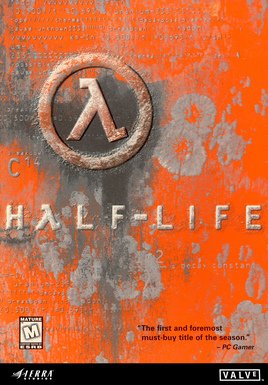
What Is Half-Life?
Half-Life is a first-person shooter developed by Valve Corporation and released for Windows on 19 November 1998. It was Valve’s very first game — the studio was founded by two former Microsoft employees, Gabe Newell and Mike Harrington, and Half-Life was the project they bet everything on. Published by Sierra On-Line, it went on to be named Game of the Year by more than fifty publications, almost unheard of for a debut game from a brand-new studio.
You play as Dr. Gordon Freeman, a 27-year-old theoretical physicist who works at the Black Mesa Research Facility, a huge secret government science complex hidden in the New Mexico desert. The game opens with Freeman riding the tram into work on a normal morning — and that slow tram ride is famous, because it is how Half-Life teaches you to look at the world instead of skipping past it. There is no opening cutscene and no big title card. You just sit in the tram, watch the facility roll past the window, and listen to the announcements. Then you put on your HEV suit, walk into the test chamber, and push a sample of pure crystal into the anti-mass spectrometer. That is when everything goes wrong.
The experiment causes what the game calls a resonance cascade. A rift opens between Earth and an alien dimension called Xen, and creatures start pouring through into Black Mesa. The facility falls apart within minutes. Scientists are killed, the power fails, and the military is sent in — not to rescue anyone, but to silence everyone who saw what happened. Freeman has to fight his way out of the facility, through the desert on the surface, and finally into Xen itself, carrying nothing but a crowbar and whatever weapons he can pick up along the way.
What made Half-Life different was how it told that story. There are no cutscenes at all — the story plays out in scripted sequences while you are still in control. A scientist runs past you screaming, a soldier kicks a door open, a Gargantua smashes through a wall. You never stop playing to watch the story. It happens to you, and that is why it still feels modern today when so many games from 1998 feel like museum pieces.
The Story of Half-Life
The story is simple on the surface and strange underneath. Gordon Freeman arrives late for work, gets into his hazard suit, and joins an experiment run by the facility’s science team. The experiment involves a crystal sample from Xen, the border world, and when the sample is pushed into the beam, the cascade begins. The facility shakes, the lights go out, and when Freeman wakes up, the test chamber is full of dead scientists and alien creatures.
From that point on, the game is a long escape. Freeman fights through the offices, laboratories, silos, and waste plants of Black Mesa, meeting the few scientists and security guards still alive. Some of them help him — they open doors, heal him, or tell him where to go. The scientists are not just decoration; they panic, they react, and some of them get killed right in front of you, which makes the place feel alive in a way that was completely new in 1998.
Then the soldiers arrive. The Hazardous Environment Combat Unit, the HECU, is sent in to contain the disaster by killing everything — aliens, scientists, and Freeman himself. They are the most dangerous enemies in the game, because unlike the aliens, they work as a team: they throw grenades, they flank you, they call out your position. Halfway through, you realise the aliens are not your only problem, and the game becomes a three-way fight between you, the creatures from Xen, and the army.
The final part of the game takes Freeman into Xen itself, the floating alien world of strange islands, low gravity, and the huge creature called the Nihilanth, which is controlling the invasion. When you finally defeat it, the game gives you a choice players still talk about today. The G-Man — the pale, suited figure who has been watching you from the edges of the whole game — offers you a job. Accept, and Freeman is put into stasis. Refuse, and he is left to die. Half-Life 2 picks up years later with Freeman waking up again, and the question of who the G-Man is and what he wants has kept fans arguing for more than twenty-five years.
Gameplay — How Half-Life Plays
Half-Life is a first-person shooter, but calling it just a shooter misses half of what it is. Yes, you shoot things — a lot of things — but you also solve puzzles, jump across gaps, climb ladders, push crates into place, turn valves, and figure out how to get past creatures too big to kill with bullets alone. The game mixes combat and puzzles the whole way through, so you are never doing the same thing for too long.
The shooting itself feels tight and fast. Gordon Freeman can run, jump, crouch, and swim, and the game expects you to use all of it. Your health and your suit power are two separate numbers on the screen, which is something Half-Life introduced and a lot of games copied afterwards. Your HEV suit absorbs damage and can be recharged at wall-mounted stations, and you pick up health kits and batteries as you go.
The campaign is divided into eighteen chapters, and it takes most players around ten to twelve hours to finish the first time. There is no hand-holding and no map marker pointing you to the next objective. You have to read the environment: a scientist tells you the power is out, so you go looking for the generator. A door is locked, so you find the vent that leads around it. That is why people call Half-Life a thinking person’s shooter, even though the action never stops.
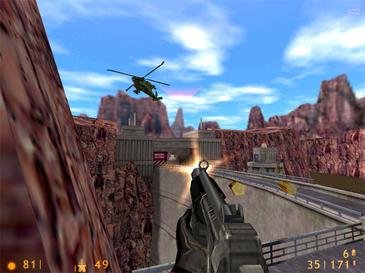
Half-Life Game Features
Half-Life was packed with ideas that were brand new in 1998, and many of them became standard in the whole shooter genre afterwards. Here are the ones that made it famous.
No Cutscenes — The Story Happens While You Play
Half-Life never takes the controls away from you to show a movie. The entire story is told through scripted sequences that play out in front of you while you are still holding the mouse. A scientist begs for help and then gets dragged away. A soldier calls in a helicopter. The G-Man steps out of a doorway and disappears before you can reach him. Because you are always in control, the scary moments feel like they are happening to you, not to a character on a screen.
A Living World Full of Friendly Characters
The scientists and security guards of Black Mesa are not background props. They talk to you, they follow you, they open doors you cannot open yourself, and they react when things go wrong. A living scientist can even heal you. This was the first time in a shooter that the people around you felt like actual people, and it changed how games were written.
Smart Enemies That Work Together
The HECU soldiers are famous for a reason. They do not just run at you — they throw grenades to flush you out of cover, they retreat when they are losing, and they shout out where they last saw you. In 1998, that kind of enemy behaviour was unheard of. The aliens are different: they hunt by instinct, they ambush you, and headcrabs can turn a dead scientist into a zombie that comes after you.
An Arsenal That Grows the Whole Game
You start with nothing but a crowbar, and by the end you are carrying alien weapons that fire living hornets and a cannon that shoots pure energy. Every weapon feels different, and every one has a moment where it is the right tool. The crowbar alone became one of the most famous weapons in gaming history.
Multiplayer and Mods That Created a Genre
Half-Life shipped with a multiplayer deathmatch mode, but its real legacy is the mods it made possible. Counter-Strike started as a Half-Life mod. So did Day of Defeat, Team Fortress Classic, and Sven Co-op. The game’s engine was so open and so easy to build on that a whole generation of game developers learned their craft by modding Half-Life. Without it, there would be no Counter-Strike, and without Counter-Strike, the entire world of competitive shooters would look different.
All Weapons in Half-Life
Half-Life gives you a big arsenal, and each weapon shows up at a moment when you actually need it. The crowbar is the first thing you pick up, and it stays useful the whole game — it is quiet, it never runs out of ammo, and it smashes the crates and vents that hide supplies. The Glock 17 pistol comes next, fast and accurate, and the .357 Magnum hits much harder but holds only six rounds.
The MP5 with its grenade launcher is the workhorse of the game, and the shotgun is the answer for anything that gets too close. The crossbow is silent and deadly at long range. Later you get the RPG for helicopters, the Tau Cannon, which fires a beam that can punch through walls, and the Gluon Gun, which melts almost anything it touches. The alien weapons are stranger: the Hornet Gun fires living insects that chase enemies, and Snarks are small explosive creatures you throw like grenades. Add tripmines, satchel charges, and hand grenades, and you have one of the most varied weapon lists of any game from the 1990s.
Enemies You Will Face in Half-Life
The enemies in Half-Life come in three groups. The creatures from Xen are the first thing you meet: headcrabs that jump at your face and turn their victims into zombies, Vortigaunts that attack with electricity, Houndeyes that hunt in packs, Bullsquids that spit acid — and the big ones, like the Tentacle in the silo, the Gargantua that shrugs off bullets, and the Gonarch, the giant headcrab deep in Xen. The second group is the human enemy. The HECU marines are the most dangerous opponents in the game because they think — they use grenades, they take cover, they try to surround you. Later, the Black Ops assassins show up, faster and quieter. The third group is the environment itself: falling, drowning, radiation, electrified water. Half-Life kills careless players in a dozen different ways.
All 18 Chapters of Half-Life
Half-Life is split into eighteen chapters, each with its own place, its own mood, and its own problems to solve. The game starts slow — the tram ride, the locker room, the test chamber — and then the pace never really lets up again. Here is the full list in order.
- Black Mesa Inbound — the famous tram ride into the facility
- Anomalous Materials — the experiment, and the resonance cascade
- Unforeseen Consequences — waking up in a ruined test chamber
- Office Complex — fighting through the offices with the first scientists
- “We’ve Got Hostiles!” — the soldiers arrive
- Blast Pit — the Tentacle in the rocket silo
- Power Up — restoring power to the rail system
- On A Rail — the long ride through the freight tunnels
- Apprehension — captured, and the first trip into the water
- Residue Processing — the waste plant and its crushers
- Questionable Ethics — the alien laboratories
- Surface Tension — fighting on the surface, helicopters and tanks
- “Forget About Freeman!” — the military’s final push
- Lambda Core — the teleport to Xen
- Xen — the alien border world
- Gonarch’s Lair — the giant headcrab
- Interloper — the factories of Xen
- Nihilanth — the final boss, and the G-Man’s offer
Most players finish the whole campaign in ten to twelve hours. The chapters vary a lot in length, and that variety is a big part of why the game never gets boring.
Expansions: Opposing Force and Blue Shift
Half-Life was so successful that Gearbox Software made two official expansion packs. The first, Half-Life: Opposing Force, came out on 1 November 1999, and it tells the same story from the other side. You play as Corporal Adrian Shephard, one of the marines sent into Black Mesa to clean up the mess. His helicopter is shot down, his squad is killed, and he ends up fighting the same aliens, the same soldiers, and a new group of creatures called Race X — all while catching glimpses of Gordon Freeman passing through the same places. Opposing Force adds new weapons, new enemies, and twelve new chapters, and on Steam it is sold as a standalone game.
The second expansion, Half-Life: Blue Shift, came out on 12 June 2001. You play as Barney Calhoun, the Black Mesa security guard, trying to escape with a small group of scientists during the first hours of the disaster. It is shorter than the other two games, but it has its own charm, and it was the first Half-Life game to include the High Definition Pack, which upgraded the models and textures of the whole series. A third expansion, Half-Life: Decay, was made for the PlayStation 2 only, and it is the only official Half-Life game with co-op play.
The Mods That Came From Half-Life
If the campaign is Half-Life’s heart, its mods are its legacy. The game shipped with tools that let anyone build on it, and the community did exactly that. Counter-Strike started in 1999 as a mod made by two fans, Minh Le and Jess Cliffe, and it became so popular that Valve hired them and turned it into a standalone game. It went on to become one of the most played shooters in history.
Day of Defeat turned the engine into a World War II team shooter. Team Fortress Classic brought class-based multiplayer to GoldSrc. Sven Co-op let friends play the whole campaign together, which the original never allowed. Fans also made entirely new single-player campaigns, weapons, and maps, and the modding scene is still active today. When you download Half-Life for PC, you are not just getting one game — you are getting the door into a library of games that all started here.
Half-Life 25th Anniversary Update — What’s New
In November 2023, Valve released the 25th Anniversary Update for Half-Life, and it is the version you will get if you buy the game on Steam today. It is free for everyone who owns the game. The most famous change is the return of Half-Life: Uplink, the original 1999 demo, which had been lost for years — it is now included as a playable mini-campaign. The update also adds four new multiplayer maps, fixes the lighting, adds proper widescreen field-of-view support, scales the interface for modern screens, and adds full controller support and Steam Deck verification.

The update also restored the original 1998 main menu and the classic Valve intro. One thing to be clear about: the game was free to keep on Steam for one weekend only, until 20 November 2023. It is not free now. The normal price on Steam is $9.99, and it goes on sale regularly for much less. If you see a site claiming the full game is free, do not download anything from it.
Half-Life vs Black Mesa Remake — Which One Should You Play?
In 2020, a fan team called Crowbar Collective released Black Mesa, a full remake of Half-Life built on the modern Source engine. It started as a free mod in 2012 and became a commercial game with Valve’s blessing. Black Mesa looks much better than the original — the graphics, the lighting, and the Xen chapters, which were completely rebuilt, are all a huge step up.
But the original Half-Life is still the one to play first. Black Mesa changes things — it cuts some parts, redesigns others, and the shooting feels different. The original is the game that changed the genre, it is much smaller to download, it runs on almost any PC, and it is the version the mods and expansions were built around. Play the original first, then Black Mesa, to see the same story through modern eyes.
Half-Life System Requirements
One of the best things about Half-Life is how little it asks from your computer. The original 1998 box asked for a Pentium 133 MHz processor, 24 MB of RAM, 400 MB of hard drive space, and a graphics card that could run OpenGL or Direct3D. Today, any laptop or office computer will run it without trying. The Steam version lists a 500 MHz processor, 96 MB of RAM, and a 16 MB video card as its minimum — far below anything sold in the last fifteen years.
| Minimum (1998) | Recommended (1998) | |
| Operating System | Windows 95 / 98 / NT 4.0 | Windows 98 |
| Processor | Pentium 133 MHz | Pentium 166 MHz |
| Memory | 24 MB RAM | 32 MB RAM |
| Graphics | SVGA video card, OpenGL / Direct3D | 3D accelerated card |
| Storage | 400 MB free space | 400 MB free space |
| Other | 2x CD-ROM drive, mouse, keyboard | Sound card, speakers |
On a modern PC, the requirements are even simpler: Windows 10 or Windows 11, any processor from the last decade, and a few hundred megabytes of free space. The game runs at hundreds of frames per second on integrated graphics. Just remember that Steam only supports Windows 10 and later since 1 January 2024, and the 25th Anniversary Update dropped Windows XP and Vista. On a modern machine, the game will just work.
Half-Life File Size — How Big Is the Download?
Half-Life is a tiny game by today’s standards. The original 1998 install took about 400 MB of hard drive space, and the Game of the Year edition was around 271 MB. A highly compressed version is commonly around 250 to 300 MB to download — smaller than a single episode of a TV show in high definition. Compare that with a modern shooter that needs 100 GB or more, and you understand why people with slow or limited internet still go looking for the compressed version of Half-Life. It downloads in minutes.
That small size is also why Half-Life is perfect for old laptops and low-end PCs. There is no huge download, no long install, no 50 GB update waiting for you. You download it, you install it, and you are in Black Mesa within ten minutes.
Half-Life Download for PC Highly Compressed — How to Get It Safely
The safest way to get Half-Life is to buy it from Steam, where it costs $9.99 and goes on sale often for just a couple of dollars. That is the only way to get the 25th Anniversary Update, the restored Uplink campaign, the new multiplayer maps, and Steam Workshop support for mods. It is a one-time purchase — no subscription, no in-game shop. Steam keeps it updated automatically, and your saves sync to the cloud.
If you are looking for the highly compressed version because your internet is slow or your data is limited, be careful where you download from. Many sites that promise a free download bundle their files with adware or worse. Half-Life is not free and it is not abandonware — Valve still sells it and still updates it. Buy it on Steam when it is on sale, which happens several times a year, and get your mods from the Steam Workshop or well-known community sites.
How to Install and Play Half-Life on Windows 10 and 11
Installing Half-Life on a modern PC is easy. Here is the whole process, step by step.
- Install Steam from the official Steam website and create a free account, or sign in to the account you already have.
- Search for Half-Life in the Steam store and buy it. It is $9.99 at full price and much cheaper during Steam sales.
- Click Install in your Steam library. The download is small — a few hundred megabytes — so it will finish quickly even on a slow connection.
- Once the download is done, click Play. The game will open in the classic 1998 menu, updated for modern screens.
- Before you start, open Options and set your resolution to match your monitor. The anniversary update supports widescreen properly, so set the field of view to 90 or higher for a comfortable modern feel.
- Start a New Game, pick your difficulty, and enjoy the tram ride. The game saves automatically at checkpoints, and you can also save manually any time with the quicksave key.
- If you want the expansions, buy Half-Life: Opposing Force and Half-Life: Blue Shift from Steam as well. They install the same way and appear as separate games in your library.
That is all there is to it. There is no compatibility mode to set and no fan patch to install. On Windows 10 and Windows 11, the Steam version of Half-Life works out of the box, which is more than you can say for a lot of games from 1998.
Half-Life Gameplay Tips for New Players
Half-Life is not a hard game once you understand how it wants you to play, but it does punish careless players. First, use your crowbar on everything — crates, vents, and boxes hide health kits, batteries, and ammunition all through the game, and smashing them is free. Second, listen to your HEV suit: when it tells you your health is low, find a health station or use a medkit before you push forward. Third, save often. The quicksave key is your best friend — save before every big fight and every jump that looks risky.
Fourth, do not waste ammunition on the big creatures. The Gargantua and the Tentacle are designed to be beaten with the environment, not with bullets — the Tentacle dies to the rocket engine, and the Gargantua can be killed with the artillery strike in its arena. Fifth, keep the scientists alive when you can: a living scientist can heal you and open doors. Sixth, learn to crouch-jump — a few jumps are only possible if you jump and crouch at the same time. And finally, turn the sound up. The skittering of a headcrab, the growl of a zombie, the radio chatter of soldiers around the corner — the game is always telling you what is coming if you listen.
Common Problems and Fixes
Half-Life runs well on modern PCs, but a game from 1998 can still have a few quirks. The most common problem is launching in a small window or at the wrong resolution — fix it from the in-game Options menu, or set your launch options in Steam. The second is the mouse feeling too fast or too slow, which is also in the Options menu, under Mouse settings.
Some players report the game crashing on the very first load. The usual fix is to verify the game files in Steam: right-click Half-Life in your library, open Properties, go to Installed Files, and click Verify integrity of game files. If the game stutters, try turning off vertical sync in the Options menu. If your saves disappear, check that Steam Cloud is turned on for the game in its Properties.
Is Half-Life Worth Playing in 2026?
Yes, and it is not even close. Half-Life is one of the few games from the 1990s that still feels like a modern game when you play it. The shooting is fast, the story is told without a single cutscene, the world feels alive, and the whole campaign is about ten hours of some of the best level design ever made. It changed how shooters tell stories, it launched Valve, and it gave the world Counter-Strike. Playing Half-Life in 2026 is not nostalgia — it is playing a game that still holds up, on any PC, for the price of a cup of tea.
It is also the perfect starting point for the whole series. Half-Life 2, the episodes, and Half-Life: Alyx all build on what this game started. If you have a weak PC, a slow connection, or a small hard drive, there is no better game to download. It is small, it is cheap, and it is one of the greatest games ever made. Download it, ride the tram, and find out why people are still talking about Black Mesa more than twenty-five years later.
Half-Life FAQs
Is Half-Life free to download for PC?
No. Half-Life is a paid game and costs $9.99 on Steam. It was free to keep for one weekend only during the 25th Anniversary celebration in November 2023, and that offer ended on 20 November 2023. The game goes on sale regularly for much less. Be careful of sites that claim the full game is free — they are usually offering pirated copies bundled with malware.
How big is the Half-Life download for PC?
The original 1998 install took about 400 MB, and a highly compressed version is commonly around 250 to 300 MB to download. The modern Steam version with the 25th Anniversary Update needs a little more space, but it is still tiny compared with modern games, which often need 50 GB or more.
Can I play Half-Life on Windows 10 and Windows 11?
Yes. The Steam version of Half-Life works on Windows 10 and Windows 11 without any compatibility settings. The 25th Anniversary Update added proper widescreen support, UI scaling, and controller support. You will need the Steam client, which only supports Windows 10 and later since January 2024.
Can I play Half-Life on a low-end PC without a graphics card?
Yes. Half-Life will run on almost any computer, including laptops with only integrated graphics. The original game asked for a Pentium 133 MHz processor and 24 MB of RAM. Any PC made in the last fifteen years will run it easily.
How many hours does it take to finish Half-Life?
Most players finish the campaign in ten to twelve hours on their first playthrough. The game has eighteen chapters. Opposing Force adds another six to eight hours and Blue Shift adds three to four.
What is the G-Man in Half-Life?
The G-Man is a mysterious man in a suit who appears throughout Half-Life, watching Gordon Freeman from a distance and then disappearing. He never explains who he is or what he wants. At the end of the game he offers Freeman a job, and your choice decides the ending. His identity is one of the biggest mysteries in gaming, still not fully answered even after Half-Life 2 and Half-Life: Alyx.
Does Half-Life have multiplayer?
Yes. Half-Life includes a multiplayer deathmatch mode, and the 25th Anniversary Update added four new maps. The game also supports the famous mods that grew out of it, including Counter-Strike, Day of Defeat, Team Fortress Classic, and Sven Co-op, which lets you play the campaign with friends.
Should I play Half-Life before Half-Life 2?
Yes. Half-Life 2 continues the story directly and assumes you know who Gordon Freeman is and what happened at Black Mesa. Play Half-Life first, then the two expansions, then Half-Life 2 and its episodes. The story is much better in order.
Is Half-Life: Opposing Force part of the main game?
No. Opposing Force is a separate expansion made by Gearbox Software in 1999. You play as Corporal Adrian Shephard, a marine sent into Black Mesa, and you see the same disaster from the other side. It is sold separately on Steam, so you do not need the original Half-Life to play it.
What is the difference between Half-Life and Black Mesa?
Black Mesa is a fan-made remake of Half-Life built on the modern Source engine and released in 2020. It has much better graphics, especially in the Xen chapters, but it changes some parts of the game. The original is smaller, cheaper, runs on any PC, and is the version the whole series and its mods were built around. Play the original first, then Black Mesa.
Final Words
Half-Life came out in 1998, and it is still one of the best games you can put on your PC. It told a story without cutscenes, it made its enemies think, and it launched a studio that went on to make some of the biggest games of all time. It is small enough to download on a slow connection, cheap enough to buy on sale for the price of a snack, and good enough to play all the way through in a weekend — and then play again with the expansions and the mods.
If you have never played it, you have been missing one of the foundations of modern gaming. If you played it years ago, Black Mesa is still waiting, the tram is still running, and the G-Man is still watching. Download Half-Life for PC and find out why this game is still talked about more than twenty-five years after it came out.
Download Half-Life for PC
Use the download button below to get Half-Life (1998) for PC. The download link will be added here.